A cellular automaton is a study in patience. You define a grid. You assign each cell a state. You write a rule that tells each cell how to update based on its neighbors. Then you press run and watch the consequences of your decisions unfold across time, often in directions you did not anticipate and could not have predicted, even though every step follows inevitably from the last. The whole enterprise rests on a paradox that has fascinated mathematicians and artists in roughly equal measure since at least the mid-twentieth century: total determinism at the local level producing genuine surprise at the global level.
Kazuhiro Tanimoto’s “Rain Blooms,” on view at NEORT++ in Bakurocho through the end of May, takes this paradox seriously. Not as metaphor. Not as aesthetic convenience. As the actual subject of the work.
The exhibition centres on a cellular automaton that Tanimoto built from the ground up over two years. This is worth emphasizing because the generative art field has a tendency to treat computational models as interchangeable skins, something you apply to get a certain look. Tanimoto’s approach is closer to materials research, which is fitting, given that he is a chemist. He has expanded the classical automaton in several specific directions: the neighbourhood structure is non-standard, with cells referencing positions beyond any fixed Moore or von Neumann grid, determined at the start of each execution either randomly or according to a pattern; multiple species coexist within the system, each governed by distinct relationships of attack, assimilation, or indifference; and each cell carries a vitality parameter, a value that rises and falls through interaction, lending the system something that reads, at a distance, like metabolism. None of these extensions are decorative. Each one changes the system’s behaviour in structural ways, opening regions of possibility that a simpler model would never reach.
The visual results are striking, but what makes them credible is that they are clearly not designed. Organic, swelling movements appear alongside linear, almost mechanical motions. Complex interference patterns form at the boundaries where these behaviours meet. Introduce a shape from outside, a gesture, a mark, and it is immediately absorbed into the logic of the grid, collapsing and proliferating and reforming as the local rules take hold. The analogy to paint dropped on canvas is Tanimoto’s own, and it is apt, though the canvas here has opinions.
It would be easy, and wrong, to position this work as a novelty within the current generative art market. The lineage is long and distinguished. John Conway’s Game of Life (1970) established the cultural grammar. Wolfram’s systematic classification of elementary automata in the 1980s demonstrated that even the simplest rulesets could produce behaviour of extraordinary complexity. Artists working with cellular automata include figures as varied as Casey Reas, whose tissue-like Process series explored emergent biological patterning, and Karl Sims, whose evolved virtual creatures used related computational models to produce forms that looked alive precisely because they were not authored. In Japan, the intersection of generative systems and physical installation has its own substantial history, from the systems art of the Gutai group in the 1950s and 60s, where the aspiration to let materials and processes act autonomously anticipated many of the concerns that generative artists now articulate through code, to the data-driven environments of Ryoji Ikeda decades later.
Tanimoto’s contribution to this lineage is specific and legible. He is not interested in cellular automata as a style. He is interested in what happens when you give a computational model enough internal complexity to behave in ways that exceed your capacity to predict. The multi-species framework is the key innovation. By introducing relationships of antagonism and assimilation between cell populations, Tanimoto creates a system that does not settle. Classical automata tend toward equilibrium or repetition. Tanimoto’s system tends toward sustained instability, a state in which the visual field remains in continuous transformation without collapsing into either chaos or stasis. This is harder to achieve than it might appear, and it is the quality that separates Rain Blooms from the many generative works that produce attractive initial states but have nothing to say about duration.
The sound design reinforces this reading. Rather than composing a soundtrack or assigning tones to events, Tanimoto derives the audio directly from changes in hue, brightness, and saturation across the grid. He selects representative pixels from the screen, assigns an oscillator to each, and converts colour change above a certain threshold into sound by mapping frequency and envelope to the pixel’s visual state. Vision and hearing share a common generative source. The result is not synesthesia in any romantic sense but something more precise: a demonstration that if both image and sound are outputs of the same computational process, the correspondence between them is not arbitrary but structural. In the immersive installation at NEORT++, this dual output fills the space, and the effect is less about spectacle than about coherence. Everything you see and hear is the same system, observed through different channels.
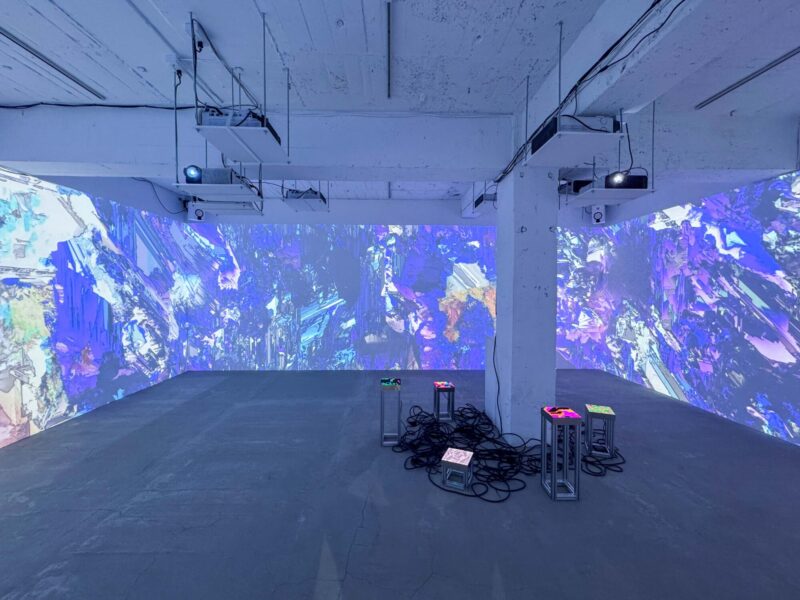
Installation view of the exhibition “Rain Blooms” at NEORT++, 2026, by Kazuhiro Tanimoto. Photography by NEORT.
The physical LED works deserve separate attention. Titled “Rain Blooms Lattice,” these are built from aluminum framing and LED panels running the algorithm on embedded ESP32 microcontrollers. They are not monitors. They do not display the work. They execute it. The distinction matters because it collapses the gap between the artwork and its medium in a way that screen-based presentation cannot. A screen is always an intermediary; a dedicated hardware piece that runs the algorithm natively is the algorithm made material. Tanimoto describes the Lattice works as specimens that reduce Rain Blooms to a simpler system and expose its operating principles, a pedagogical function that acknowledges what he articulates clearly in conversation: that to appreciate technology-based expression, one needs to raise one’s resolution with respect to technology. The fact that the core algorithm can be ported to a microcontroller at all is itself a statement about the system’s compactness, a quality Tanimoto values. This is not a program that depends on the enormous shared infrastructure of a PC. It is small enough to run on its own.
The institutional frame around the exhibition is also worth registering. “Rain Blooms” arrives as a collaboration between NEORT and Art Blocks Studio, with a 128-edition digital release on Art Blocks. NEORT has operated its Bakurocho gallery since 2022 and has steadily built a curatorial program around code-based practice in Japan. Art Blocks, having completed its 500-project canon in 2025, occupies a comparable position in the American and European generative art ecosystem. The partnership is presented as a bridge between these communities, and the framing is not merely commercial. Both organizations have demonstrated a commitment to generative art as a curatorial category with its own critical standards, not a subcategory of digital collectibles. That Tanimoto’s work is the vehicle for this first joint initiative suggests a shared recognition that the most durable contributions to the field come from artists who treat computation as a discipline, not a shortcut.
What “Rain Blooms” ultimately offers is a reminder that the most productive question in generative art is not “what does it look like” but “what kind of system produced it.” Tanimoto has built a system with enough internal richness to sustain attention across time, and he has done so by working at the level of rules rather than appearances. The blooms that emerge are beautiful, but their beauty is a consequence, not a goal. The goal is the system. The system is the work.
Rules, Not Forms: A Conversation with Kazuhiro Tanimoto
“Rain Blooms” is on view at NEORT++ in Bakurocho through May 31. The 128-edition release on Art Blocks Studio goes live on May 22.
What follows is a conversation with Tanimoto about the logic of his system, the aesthetics of emergence, and what it means to design rules rather than forms.
On the system itself
You spent two years developing the cellular automaton at the center of Rain Blooms. Can you describe what the development process looked like in practice? Were you primarily testing visual outputs and adjusting rules, or did the work proceed more formally, closer to how you might approach a problem in chemistry?
In practice, both were intertwined, but the formal side accounted for a very large proportion of the process.
Cellular automata are often described as systems in which “complex behavior emerges from simple local rules,” but in reality, most rules quickly diverge, or conversely converge into monotony. Cases like the Game of Life, where interesting behavior appears, are quite exceptional within cellular automata as a whole.
For this reason, in the early experiments with my original cellular automaton, the system quickly diverged or converged, and I could not see the kind of behavior I wanted at all. So I repeatedly thought about what kind of mechanism it should be, built a testable system, set various rules, experimented, failed badly, considered where the cause was, and rebuilt it again and again. Of course, I judged failure visually, by looking at the output, but solving the problem required returning to the system and the rules and changing them. That kind of non-visual activity occupied most of the first half of the process. It was indeed close to the feeling of approaching a problem in chemistry, where you repeat experiments while imagining something invisible. Incidentally, this was not a matter of having a fixed system and adjusting the parameters fed into it so that it looked good. It was a matter of remaking the design of the system itself.
Once the direction of the system had become somewhat settled, I continued developing it by repeatedly judging the behavior and diversity visually, then changing and adding rules. Even then, however, the rules did not directly specify movement. They were mechanisms through which movement appeared as a result, so the process remained a constant search.
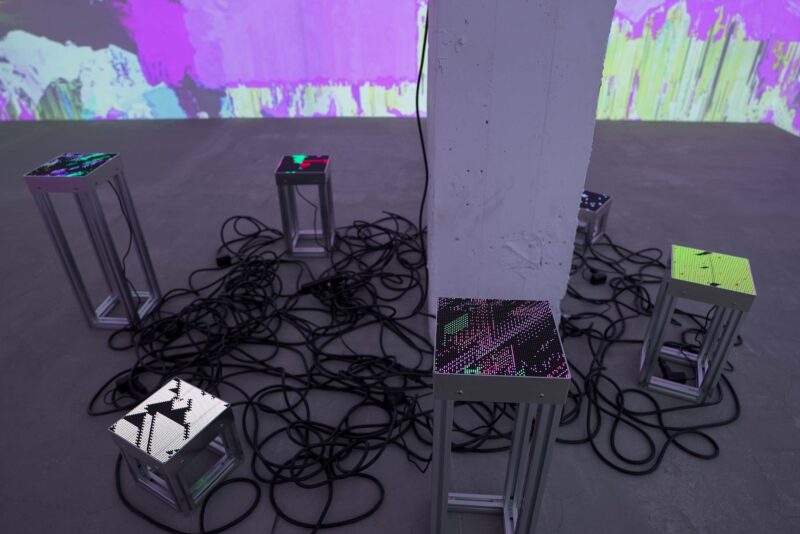
Installation view of “Rain Blooms Lattice” at NEORT++, 2026, by Kazuhiro Tanimoto. Photography by NEORT.
Classical cellular automata typically use fixed neighborhood structures. You have expanded the definition of neighboring cells and introduced multiple species with distinct interaction types. At what point in the process did you realize the classical model was insufficient for what you were trying to achieve, and what specifically did you need it to do that it could not?
There were two stages before the direction I should pursue with Rain Blooms became clear to me. First, in early 2024, I began working seriously with ALife and became drawn to the interest and depth of cellular automata. But in my experiments using the Game of Life, I could not create a different character for each execution, and the movement was also highly isotropic, so there was a limit to the diversity. For that reason, I felt quite early on that I needed an original system. What I needed was not something where black and white, or at most about four colors, blink on and off, but a much more complex and diverse computational world, something a human could never fully draw by hand. That became the foundation I started to aim for.
The other important moment for me came when I participated in the group exhibition Patterns of Flow at NEORT++ in Tokyo in September 2024, curated by AXEL of Right Click Save and Shono Yusuke of NEORT, and encountered the thinking of Hiroshi Kawano, a pioneer of Japanese computer art. In particular, I was strongly drawn to the ideas in Kawano’s book The Birth of Network Aesthetics. There, he presented a bottom-up concept in which independent agents without a central command tower interact with one another and thereby form the final structure. I came to want to materialize that idea through cellular automata.
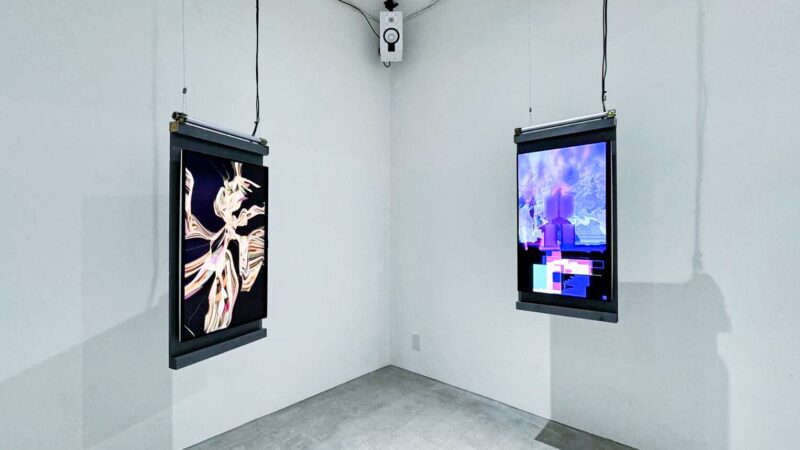
Installation view of “Sea of Code” at NEORT++, 2024, by Kazuhiro Tanimoto. Photography by NEORT.
The vitality parameter is an interesting addition to the system. It implies a kind of metabolism or life cycle within the cells. How does vitality interact with the species relationships? Is a cell’s vitality affected by whether its neighbors are hostile, assimilative, or indifferent?
As you suggest, the treatment of vitality changes depending on the relationship. The direct interactions that occur between species are of three kinds: attack, assimilation, and ignore. In the case of attack, the winning cell also absorbs the opponent’s vitality. In the case of ignore, no exchange of vitality occurs. When assimilation takes place, vitality is shared slightly. As a result of these exchanges, the vitality held by each cell affects the outcome of the next attack. This vitality is one of the factors behind the complex behavior in this system.
That said, vitality is only a technical method for realizing a complex computational world. It is not intended to simulate life accurately.
When you introduce a shape from outside the system, you describe it as behaving like “paint dropped onto a canvas” that immediately becomes part of the automaton. How does the system absorb external input? Is there a moment of rupture before integration, or is the transition seamless?
The transition is extremely seamless. The cellular automaton calculations are performed all at once on the GPU for each frame, generating the next frame. Before running the GPU calculation on the previous frame, I draw simple shapes into that frame. I then pass the frame with the added shapes to the GPU and run the cellular automaton calculation. The GPU then calculates the next frame as one in which those shapes exist. There is no moment when the inserted shapes are not behaving as part of the automaton.
On authorship and emergence
You have described Rain Blooms as a process where the final form is not directly determined by the artist. But you did design every rule. How do you think about the boundary between what you authored and what the system authored? Is that distinction meaningful to you?
At this point, I am not very conscious of a distinction between the system I designed and the output of that system. As long as I explicitly design a system from scratch, even if the direction being aimed for were the same, the concrete system built by each person would differ, and the output produced by that system would also differ. In painting, this is similar to how the combination of paints used, the brushes used, and the movement of the hand differ from person to person, so that even if the same subject is painted, the result becomes a different work depending on the artist. I think that kind of difference is precisely what should be called authorship, and authorship resides both in the system and in the output. Even when the system produces something beyond my own imagination, the system and the output are inseparably and seamlessly connected, and I feel that it is my work, not someone else’s.
What is important here is that it is currently impossible to construct a system that is 100 percent pure, in which no human will intervenes at all, and I am not aiming for that either. Even so, I want to build a system in which human intention has been stripped away more than in ordinary methods. A purity of 10 percent and a purity of 80 percent have different significance. This is an experiment in whether something exists at the very limit of what is realizable. It is not a binary question of zero or one, but a matter of gradation.
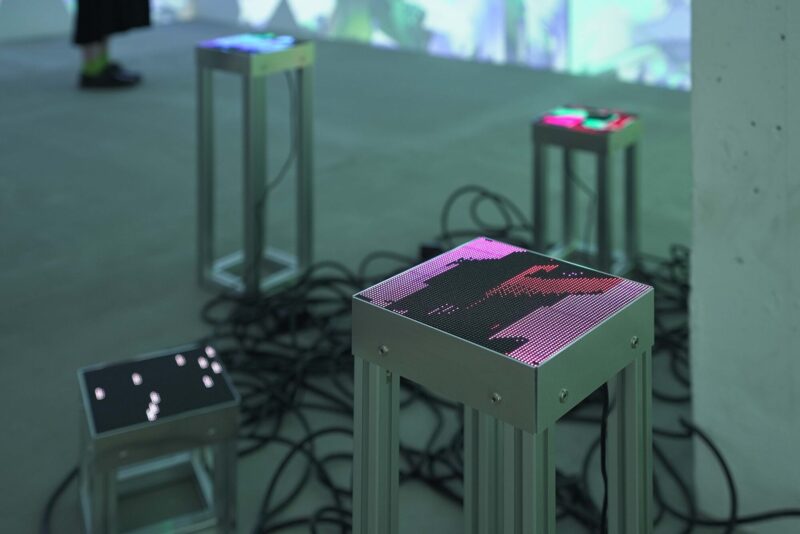
Installation view of “Rain Blooms Lattice” at NEORT++, 2026, by Kazuhiro Tanimoto. Photography by NEORT.
There is a long history of artists working with cellular automata and related systems. Do you position your work within that lineage consciously? Are there specific predecessors, in art or in science, whose thinking shaped your approach?
In terms of lineage, I would place my work less in the stream that uses cellular automata as scientific models, and more in the stream of computer art and generative art that has treated them as devices for generating visuals and sound.
Also, this is not a question of what is correct, but of what kind of thing one wants to make. I aimed for a world in which extremely diverse and complex situations arise. It is not a pattern generator using one-dimensional cellular automata, nor a simple demo for showing a concept. I wanted to make it work as a piece with enough density that viewers could observe it for a long time, discover something different each time, and connect what they found to phenomena or concepts around them.
This may be due to the limits of my own research, but I did not find many works that felt like direct visual reference points. For that reason, my starting point was the Game of Life.
For audio, I feel Christoph Stähli’s Game Of Sound is very close. It overlaps with Rain Blooms in its interest in generating ambient sound by mapping changes in cells to sound.
In that sense, I think Rain Blooms starts from the history of the Game of Life and cellular automata, and attempts to reconstruct them not as mere pattern generation, but as a visual and sonic environment that can be observed over time.
Your artist statement refers to “forms of expression unique to the computer.” What do you mean by that? Is there something the computer produces through computation that could not, in principle, be achieved by other means?
At present, I cannot state definitively whether forms of expression unique to the computer truly exist. But I do want to explore them, and I do not think something has no value for consideration unless it is 100 percent pure. I am thinking about forms of expression for which there is a strong necessity to use the computer.
For the moment, I will define “computer” in the narrow sense: a modern electronic calculating machine, designed and manufactured by humans, capable of high-speed computation. In ordinary production environments, I recognize the computer as the medium with the strongest aptitude for handling large amounts of computation at high speed.
What is important to me is not whether someone could later use the result as a model and draw something similar. What I care about is whether the image was produced as something directly imagined by a human as a completed form, strongly inheriting human sensibility and thought processes, or whether it is an image that appears as the result of an enormous accumulation of computational rules, and is difficult for human thought to arrive at.
If we look at only one frame of Rain Blooms, a human might be able to imitate it by hand with enough time. Even if that increases to 10 frames or 100 frames, it would be hard to say that it is impossible in principle. But if you wanted to make it move for one hour, at 30 fps you would need to draw 10,800 frames. I cannot state definitively that this is impossible in principle, but in practice it comes very close to impossible. In other words, there is a large gap between what is possible in principle and what is possible in practice. I strongly distinguish between these things.
As a result, there are at least two elements in what I feel to be computer-like expression. One is that, as a result of high-speed computation, images arise that are difficult for humans to directly imagine as completed forms. The other is that, through the repetition of high-speed computation, they continue moving as temporal change.
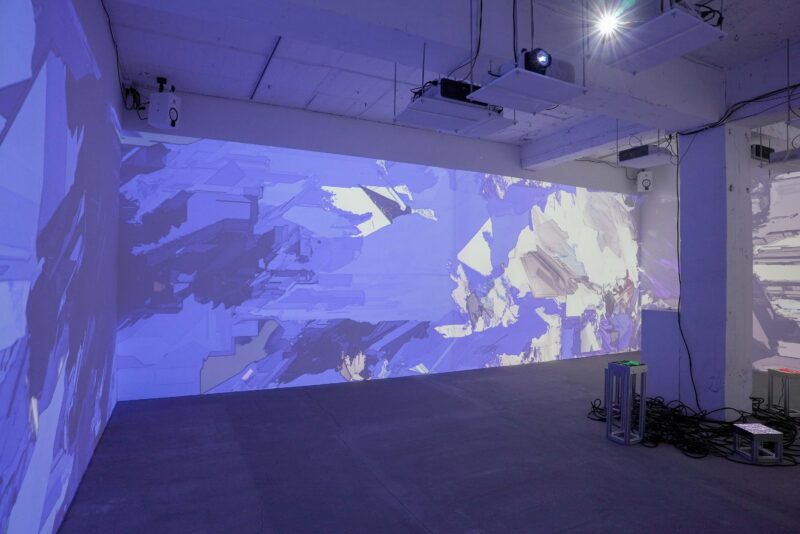
Installation view of the exhibition “Rain Blooms” at NEORT++, 2026, by Kazuhiro Tanimoto. Photography by NEORT.
On sound and immersion
The sound in Rain Blooms is generated directly from the visual state of the cells, from changes in hue, brightness, and saturation. Did the sonic dimension emerge naturally from the system, or did you have to design a translation layer? How do you evaluate whether the sound is working?
I have not touched on this much up to this point, but I also feel that being able to generate visuals and audio simultaneously in real time expands expression through the computational power of the computer. Originally, I introduced sound with the intention of creating the rustling or murmur of the cells. I choose 20 x 20 representative pixels from the screen and assign an oscillator to each one. Based on the position of each pixel, I determine where the sound is heard from left to right. When the change in color of that pixel exceeds a certain threshold, I convert it into sound by assigning frequency and ADSR according to its hue, brightness, and saturation. In other words, I am translating the visuals into sound, so it may be unnatural to say that the sonic dimension emerged naturally from the system. In addition, the harmony is assigned to chords based on chord progressions, which directly uses music theory constructed by humans. This audio aspect should be called a very human expression, and in this sense there is also a collision here between ideal and reality.
I evaluate whether the sound is working less by whether it is complete as music on its own, and more by whether the density of change and the murmur within the screen can also be felt auditorily. If it allows the work to be felt not as a mere video but as an environment, then I consider the sound to be working.
The exhibition is described as immersive, with the viewer placed inside a continuously transforming environment. What does immersion mean to you in this context? Is it about scale, about duration, about the absence of a fixed vantage point?
I think it is all of those things. Immersion requires that much of the field of vision be occupied by the work, that even when the viewer moves their point of view they can remain inside the changes of the work, and that there be a duration that does not create a sense of interruption. It is also the ability to focus on changes in small local structures, to step back and grasp the larger composition produced by their accumulation, and to move back and forth between those modes, producing an experience of entering into a world. NEORT++ is a wonderful gallery, very rare in Japan, with both the technical ability and the intellectual receptivity to realize this. Their contribution to this work is immeasurable, and I am deeply grateful that they have brought me this far.
On materials and context
You are a chemist by profession. The language you use to describe your work carries echoes of physical and chemical processes. Is there a direct conceptual link between your scientific work and your artistic practice, or are these parallel interests that happen to share a vocabulary?
There are both parts where my work in chemistry and my artistic practice are directly connected, and parts where they overlap as parallel interests. Rain Blooms is not a work that directly simulates a specific chemical reaction or physical phenomenon. However, ideas such as generation, transformation, collapse, and interaction are deeply related to the way I have seen the world as a chemist. In chemistry, the properties of molecules or materials are not determined by a single element alone. Molecular structure, interaction, environment, time, concentration, temperature, and other factors intertwine, and behavior appears as a whole. It is important to break things down into elements, but that alone sometimes does not let you see the behavior or interest of the whole. This way of seeing also feels close to how I look at social phenomena, not only materials. The overall state arises not from individual elements alone, but from their relationships and temporal changes.
In Rain Blooms as well, I am dealing not with a single center or one meaning, but with phenomena that arise bottom-up from the interactions of many elements. I think my scientific interests are connected to the attitude of not reducing the work to a single message, but of observing complex things while keeping them complex.
The way hypothesis testing and failure are treated in research has also influenced my practice. When the intended result does not appear, I do not simply look at the output and adjust it. I return to the mechanism, consider the cause, and rebuild the model or conditions. That repetition is common to both research and production.
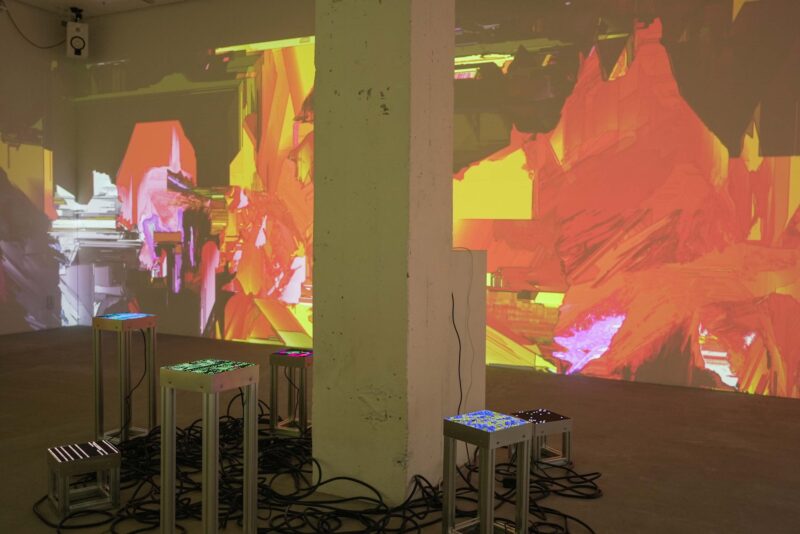
Installation view of “Rain Blooms Lattice” at NEORT++, 2026, by Kazuhiro Tanimoto. Photography by NEORT.
The physical LED works in the exhibition run the algorithm on embedded microcontrollers rather than displaying pre-rendered output. What was the motivation for building custom hardware? Does the physical work function differently for you than the digital edition?
First, the physical LED work, “Lattice,” has a role like a specimen that gradually reduces Rain Blooms to a simpler system and shows its operating principles. In the exhibition, if the final Rain Blooms were simply projected on four walls, it might be perceived as a general CG video. I think this is true of all produced objects, including paintings and sculptures, but to enjoy a work deeply, one needs knowledge related to it. In the case of Rain Blooms, I feel it is necessary to explain as much as possible what technologies are being used, what kinds of rules act to produce this result, and how those rules changed step by step before finally arriving at Rain Blooms.
In general, something like this can be received as a mere technical demo or as a device for positional rhetoric, but I feel some discomfort with that view. Fundamentally, people have high resolution in relation to what they like or in their fields of expertise, and in those areas they can recognize and interpret subtle differences as beauty or interest. On the other hand, for areas outside that, their resolution is lower, so they may feel that they cannot tell how it differs from what came before, or cannot understand its beauty or interest. This is not originally something specific only to technology-based expression. Expression based on human sensibility and thought, and expression based on technology, each have their own beauty and interest. To understand the interest of technology-based expression, one needs to raise one’s resolution with respect to technology. Even if it is impossible to achieve that perfectly, this is an attempt to realize it even a little.
Second, I am drawn to “small systems.” It may be something like a sense of competition, but I feel surprise and a small joy when diverse phenomena arise from a mechanism with a data size small enough to be uploaded onto a blockchain. However, a small program size on a PC does not necessarily guarantee that the system is small. The OS, graphics drivers, and other infrastructure that execute the program are built in, and the program is using them. But the fact that the core algorithm can be ported to a microcontroller, an ESP32, that controls LEDs, shows that it is a system small enough to operate without depending on the enormous shared infrastructure of a PC.
This project marks a collaboration between NEORT and Art Blocks Studio, framed as a step toward connecting Japanese generative art with international audiences. How do you see the relationship between the Japanese generative art community and the broader international scene? Is there something specific about the context in Japan that shapes the work being made here?
Over the past several years, I have been involved with both Art Blocks and NEORT, each in an independent way. NEORT is an organization that combines sincerity with bold execution, and there is no doubt that it has earned the strongest trust from the Japanese generative art community. At the same time, in Japan, digital art, and especially the generative art community within it, is still by no means a mainstream presence. I also think NEORT has not been rewarded enough in proportion to the scale of its contribution to this scene.
In that situation, it is a great honor that my work can create one point of contact among Art Blocks, NEORT, which is internationally recognized, and the Japanese digital art scene. I also think it is an opportunity for practices and communities built up in Japan to be seen more widely.
As for the work itself, I did not consciously try to incorporate Japanese imagery or regional character into Rain Blooms. However, I can think about my practice within a flow in Japan where computer art and craft-like refinement have overlapped. What I am interested in now is the question of how expression using computation by computer can turn vision, sound, time, and space into a work. I think that question can be shared not only within Japan, but also in the international field of generative art.

Exhibition Information
Dates: May 15, 2026 – May 31, 2026
Venue: NEORT++, maruka 3F, Nihonbashi Bakurocho 2-2-14, Chuo-ku, Tokyo
Kazuhiro Tanimoto
Kazuhiro Tanimoto is a chemist engaged in materials research and development, working with generative audiovisual expression using computers. His practice centers on building real time generative systems that leverage computational processing power. He is interested in dynamic transformations driven by algorithms such as cellular automata, as well as processes of generation, transformation, and collapse that resonate with material and social phenomena, and in forms of expression unique to the computer that emerge from these computational processes. His works are included in the Rhizome ArtBase and have been selected for Art Blocks Curated. His exhibitions include WSA in New York, VA HUB in Taipei, NEORT++ in Tokyo, and Art Blocks Gallery in Marfa. He was also selected as a Jury Selection in the Art Division of the 21st Japan Media Arts Festival.
Joana Kawahara Lino
Joana Kawahara-Lino is a Portuguese-Japanese writer, curator, and cultural strategist based between Lisbon and Athens. She is the founder of Museum Ghost, a platform for cultural criticism and artist interviews in the digital art space, and LORE Studio, a narrative and experience agency working across Web3 cultural ecosystems. Previously, she served as Founding Curator of the Seattle NFT Museum and held roles at Art Blocks and Foundation. She holds a background in Architecture and a Master’s in Culture, Policy, and Management.