Three machines housed in transparent acrylic cubes continue computing for as long as they are powered on. The machines monitor their own temperature and load, as well as the surrounding radio signals, and generate visuals in real time based on these conditions. When an auction ends, the data needed to reproduce the work at that moment is extracted and recorded on the blockchain. Quietus Machine, a project by NEORT++ and Art Blocks, treats the physical machines that produce generative art as part of the artwork itself. The first exhibition took place in October 2026 at Art Blocks Marfa Weekend in Marfa, Texas, and works by three artists will be auctioned at NODE in Palo Alto on November 14 and 15. Here, I would like to look back at how the concept emerged and what changed as production progressed.
It began when I was looking at a computer circuit board and found myself drawn to its beauty. A CPU placed at the center, memory and power supply components surrounding it, resistors and capacitors the size of grains of rice. Thin traces run in parallel between them, turning neatly at the corners. This layout, which resembles a city viewed from above, is determined by the technical requirements of how electricity should flow. I was intrigued that something designed to perform a function could possess such a distinctive formal beauty, and began to wonder whether I could build a computing device like a Raspberry Pi myself.
At around the same time, I was planning an exhibition that would reconsider Gustav Metzger’s auto-destructive art within the contemporary information environment. What would happen if the ideas of auto-destructive art proposed by Metzger were transposed into the realm of information and computers? Information is easy to copy and store, and tends to be seen as though it were free from material constraints. In reality, however, physical devices are needed to process and store it. And those devices have a lifespan. As I thought about these things, the idea emerged of making the continually computing machine itself into an artwork. A machine that measures its own temperature and elapsed time, and continually displays its state. It keeps running for as long as it is supplied with power, but as a physical entity, it will eventually cease to function. The name “Quietus” came from this interest in finitude.
One of the works I referred to while developing the concept was Hans Haacke’s Condensation Cube (1963–65). In this work, water evaporates inside a transparent acrylic cube and condenses on its inner walls in response to changes in room temperature and light. The patterns of condensation are not fixed, but continually change according to the environment in which the work is exhibited. Rather than the artist determining a finished form, the physical process that takes place in relation to the environment is itself the artwork. This way of thinking also connected with my idea of observing a machine’s state and incorporating changes in that state into the work.
Meanwhile, as I investigated the feasibility of making a custom circuit board, it occurred to me that I might be able to use a product not sold as a computer as a computer. Many products around us contain computers. As I looked into this, I learned that some everyday Wi-Fi routers run on Linux-based operating systems, and that replacing the operating system with the open-source OpenWrt would allow me to run programs freely. I therefore decided to repurpose a commercially available Wi-Fi router instead of building a circuit board myself.
The arrangement of placing a Wi-Fi router inside a transparent cube and making the computational processes running within it into an artwork ended up closely resembling Trevor Paglen and Jacob Appelbaum’s Autonomy Cube (2014). Autonomy Cube houses computers that act as relays for the anonymous communications network Tor inside a transparent cube, so that the sculpture in the gallery simultaneously functions as actual network infrastructure. Although I had not set out to follow this work’s configuration, I had, by chance, arrived at something similar: taking ready-made networking equipment out of its original role and running it inside a transparent box.
rudxane proposed reflecting the bustle of people gathering around the Wi-Fi router in the work. I therefore tested whether receiving Wi-Fi signals emitted by nearby smartphones would allow me to detect the number of devices and changes in the radio signals. Although this does not provide an exact headcount, I found that it could capture the presence and movement of people nearby to some extent without identifying individuals. In Here with me, which uses this mechanism, fine pink and purple lines overlap against a pale background, bending like wiring to form a three-dimensional structure. The temperature of the router’s chip determines the colors, and pulses of heat are fed into the on-screen structure according to the number of devices detected. The time, temperature, and device count are also displayed in a corner of the screen, allowing viewers to compare changes in the forms with the actual measurements. Even without viewers performing any particular operation, their presence in the same space as the machine is reflected in the visuals.
In addition to the presence of people nearby, how the machine itself has been working also provides a basis for generating visuals. In Timescale, Takens Theorem focused on how CPU load changes over time. The difference between the one-minute and fifteen-minute load averages is integrated over time, linking the progression of computation to movement on the screen. The visual expression is based on die photographs of the internal structures of microchips. Drawing on geometric structures formed by arrays of microscopic circuitry, the work depicts an imaginary chip with shifting lines and glowing areas. Values representing the presence and movement of people nearby, as well as temperature, are also layered into it. Photographs of semiconductor chips show static structures, yet electronic activity continues inside them. As Takens Theorem puts it, “It is the chip’s fixed appearance that is the illusion.” Activity invisible in photographs emerges as moving imagery. A machine performing computation reads its own state and uses it as material for the work. The device doing the computing also becomes the subject of that computation. This self-referential structure is a characteristic of the work.
Memory, which supports computation, also depends on the physical state of its components to retain information. Satoshi Aizawa’s Disturbed Memory alters stored character strings by acting on that state. DRAM retains information through minute electrical charges, but certain patterns of access to a row can affect the charges in adjacent cells, sometimes causing bits to flip. Aizawa uses an error that would normally be avoided to generate the work. A 256-byte string made up of Linux commands executed by the machine itself is stored in memory. As the memory is acted on, bit flips gradually change parts of the string. The results accumulate on the screen like overtyping on a typewriter. Because the region to be affected is selected according to the strength of the surrounding radio signals, the movement of people in the venue also indirectly contributes to changes in the string. Incidentally, this was the only work for which we used a PC supplied by the artist. This was to make direct use of the physical properties of DRAM, the main memory, in generating the work.
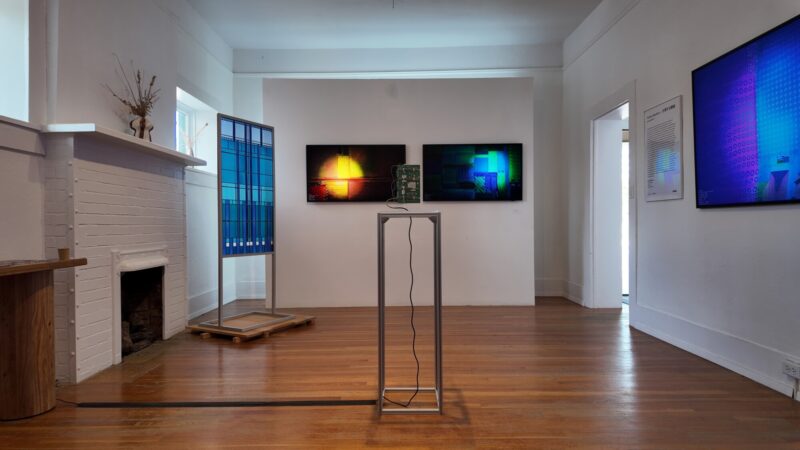
Takens Theorem, Timescale
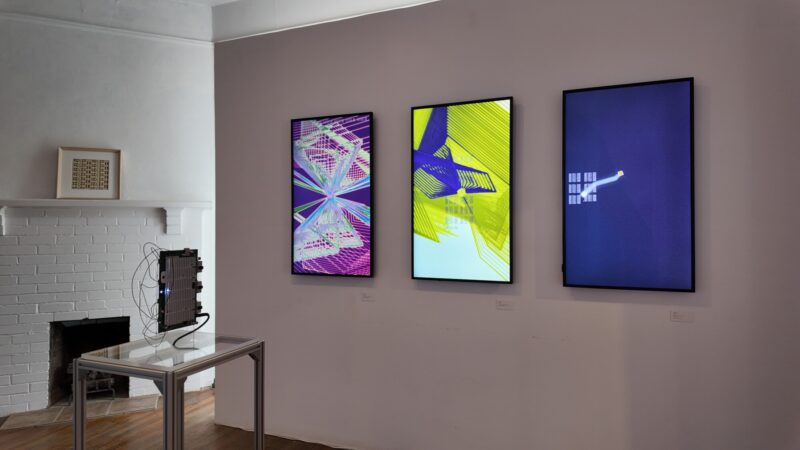
rudxane, Here with me
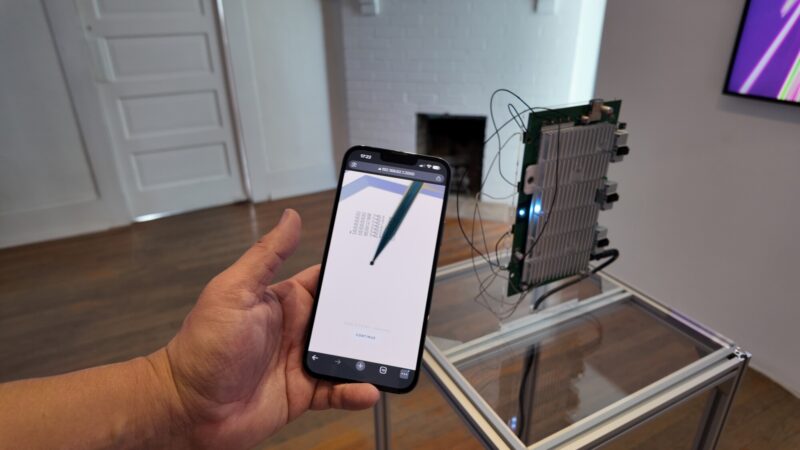
rudxane, Here with me
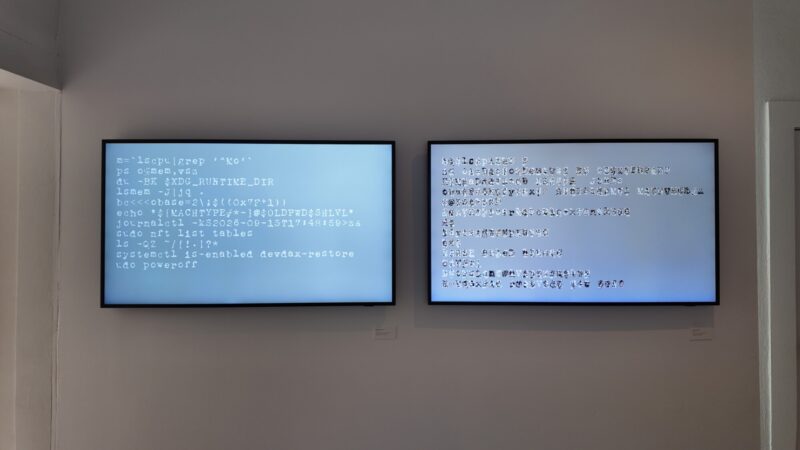
Satoshi Aizawa, Disturbed Memory
In October 2026, we held the first exhibition at Art Blocks Marfa Weekend in Marfa, Texas. The materials we had shipped were held at customs and did not arrive, so the installation was touch-and-go, but we somehow managed to put the exhibition together. The venue was Art Blocks House, a welcoming space filled with natural light. We assigned each of the three artists a room and arranged the works around the machines. Marfa is also the town where Donald Judd developed his work in relation to the land. Exhibiting there, I felt an affinity between the idea of creating work in relation to its environment and Quietus Machine, which creates connections among the work, its audience, and the surrounding environment.
In his article “Coding a New Gift Economy” for Outland, Brian Droitcour focuses on how Quietus Machine presented the hardware as part of the work and organized the exhibition space around the processes taking place inside it1. At the same time, he sees the conditions nurtured in Marfa, where places are provided for presenting work, equipment and knowledge are shared, and different organizations are brought together, as part of a “gift economy.” A gift, in this sense, does not only mean giving something away for free. Even when a work has a price, not all of its value can be explained by that price. This way of thinking does not reject buying and selling; it also looks at the relationships around them that make production and presentation possible.
Things continued to fall into place, one after another. Quietus Machine would also be exhibited at NODE in Palo Alto on November 14 and 15. The machines transported from Japan to Marfa will head straight to Palo Alto. From one place in America to another, Quietus Machine, a physical entity, travels.
At NODE, the mechanism through which exhibition visitors influence the work is extended online. Auction participants are also included as exhibition participants and can influence the work. rudxane summed up this mechanism in a phrase: Mixing physical and digital “attendance.”
The auctions will run from 12:00 on November 14 to 19:00 on November 15, Pacific Time, or from 05:00 on November 15 to 12:00 on November 16, Japan Standard Time. Each time an auction ends, the data needed to reproduce the work at that moment is saved as “Memory.”
When I first thought of making my own circuit board, I never imagined that Quietus Machine would become the work it is now. It takes in not only the state of the machines themselves, but also the presence of people at the venue and of those taking part in the auction online. Besides the Wi-Fi routers, we also ended up sealing a PC circuit board in acrylic, which I had not anticipated at the start. As I designed the machines, exchanged ideas with the artists, and ran them in actual environments, the way the work functioned gradually changed. Quietus Machine itself is also moving on to different places as new opportunities arise. Part of that activity remains recorded on the blockchain, but the physical machines continue to compute separately from it, and will eventually cease to function.
- Outland, “Coding a New Gift Economy”
https://outlandart.substack.com/p/coding-a-new-gift-economy
Quietus Machine — NEORT++ × Art Blocks
Auction and artwork information
https://two.neort.io/en/exhibitions/quietus_machine
Auctions
Takens Theorem, Timescale
https://two.neort.io/en/exhibitions/quietus_machine/works/takens-theorem
rudxane, Here with me
https://two.neort.io/en/exhibitions/quietus_machine/works/rudxane
Satoshi Aizawa, Disturbed Memory
https://two.neort.io/en/exhibitions/quietus_machine/works/satoshi-aizawa